
March 23, 2026

This page relates to these three pages:
19th-20th Century Boys’ & Men’s Football in Essex County
19th-20th Century Boys’ & Men’s Rugby in Essex County
19th-20th Century Boys’ & Men’s Soccer in Essex County

The above guide was created as a reference by me while attempting to locate and sort images and historic details about Essex County boys’ and men’s football, rugby and soccer teams in the 19th and 20th century. I look forward to expanding the pages as new information and photographs are located.
As the author of this genealogy resource site, I must give a disclaimer — I’ve never played football, rugby, or soccer. So I found writing and compiling these pages challenging. My knowledge is limited to recognizing a goal by the cheers and the winning team by their exuberance at the end of the game.
I came close to learning about the rules of football once, when my geography teacher gave me an after school detention. While I was seated at the back of the classroom it filled up with boys. It turned out that the teacher/coach prearranged a meeting for football tryouts. They passed a clip board around to sign up, so naturally I did — I wanted to give the impression I was there for a reason, although I never intended on partaking in the season. The next day I was called to the principal’s office and read the riot act. Fortunately, I left there with a Cheshire cat grin after I reminded them how inappropriate it was to have a young lady forced to sit at the back of a classroom full of football players simply for being a few minutes late to class.
While sorting 19th and 20th-century images and facts for this site I had difficulty differentiating between football, rugby and soccer. And it didn’t help reduce my angst when I read a renowned ball makers wife and the mother of his seventeen children died with infected lungs from blowing up pig bladders by mouth! It did explain however why the balls during that period weren’t entirely spherical (round), ovoid (oval) or consistent in size.
On the upside while reviewing photos and news articles I found many images to share and reasons to applaud the skill and talent of Essex County players and teams “back in the day” whose legends live on, which is my goal.
Kudos to the Southwestern Ontario Digital Archive (SWODA) and to the Tony Techko Collection and other generous donors. Thanks to generous contributions SWODA maintains a treasure trove of sports images that are available to the public. The explanatory notes they include with the images about local history and the subjects are interesting and helpful.
To record history and attempt to comprehend the difference between football, rugby and soccer I read online books available at Internet Archive. The are extension laws, rules and variation of how these games are played. I was astounded at the level of knowledge required to coach and referee these sports. Links to the books available for viewing or download at Internet Archive are below.
A few images on SWODA had both soccer and football as the subject and wondered why. I also noted a team photo where the ball held looks spherical (round) in shape – more like a soccer ball, yet the image was clearly labelled football. To follow are a few examples:
Windsor Rovers Football Club Year: 1914 Type(s): Photograph Physical Description: Sepia; 18×13 cm Source: Walkerville Times Collection; donated by Neil J. MacPhee Notes: 1913/1914; Fred Johnson is second from the left Subject(s): Windsor Rovers Football Club Soccer, Clubs, Johnson, Frederick William”

Walkerville Football Club 1926-1927 “Actually Soccer”:

Walkerville Football Club 1926-1927 Year: 1927 Type(s): Photograph
Source: Tony Techko Collection Notes: Actually soccer
Source: Southwestern Ontario Digital Archive Tony Techko Collection
To complicate matters further I discovered that in 1861, Richard Lindon was the“principal football maker” and also made the “Big-Side Match Ball”, which was recognized as the true “rugby” ball. I thought to myself , “Why is the principal ‘football’ maker custom making ‘rugby’ balls?” and that took me down another rabbit hole. I was ready to delete the pages and make the only kind of pass I really know how to do well – give up! Yes that pun was intended and you can’t blame me after all this is a hobby.
“By 1861 Richard Lindon was recognised as the principal Foot-Ball Maker to Rugby School, Oxford, Cambridge, and Dublin Universities. Lindon’s “Big-Side Match Ball” was recognised as the true rugby ball and was successfully manufactured by both Richard Lindon and subsequently, his son, Hughes John Lindon for 50 years.”
Source: https://en.wikipedia.org/wiki/Richard_Lindon
Since reading online books was taking me further down the rabbit hole, I decided to do more research and create a time line and to follow is what I came up with – so far. As always, it is subject to addition or revision if useful evidence or information comes available.
TIMELINE OF FOOTBALL, SOCCER & RUGBY
In Ancient Rome (c. 509 BC to 476 ad) ball games were popular for fitness and recreation. The Romans called their ball game“harpastum” a word derived from the term “to seize”. To seize indicates hands as well as feet were used. A larger “kind of ball” was used and to opposing “companies”. The object was to throw the ball another’s “goals” for the “conquering stroke”. Some claim football was introduced in Northern Europe to the Roman legions.
In the middle ages (476-1500) kicking a ball around for fun and sport was recorded.
In 1389 servants were prohibited from playing tennis or football, and other games.
Calcio storico fiorentino is an early form of football that originated during the Middle Ages in Italy and is still played in Florence.
Calcio Fiorentino match in Piazza Santa Maria Novella in Florence, Italy, painted by Jan Van der Straet

The following image etched in 1688 depicts “florentine football” being played, for links to the book and a related auction sale made at Christie’s see links below:
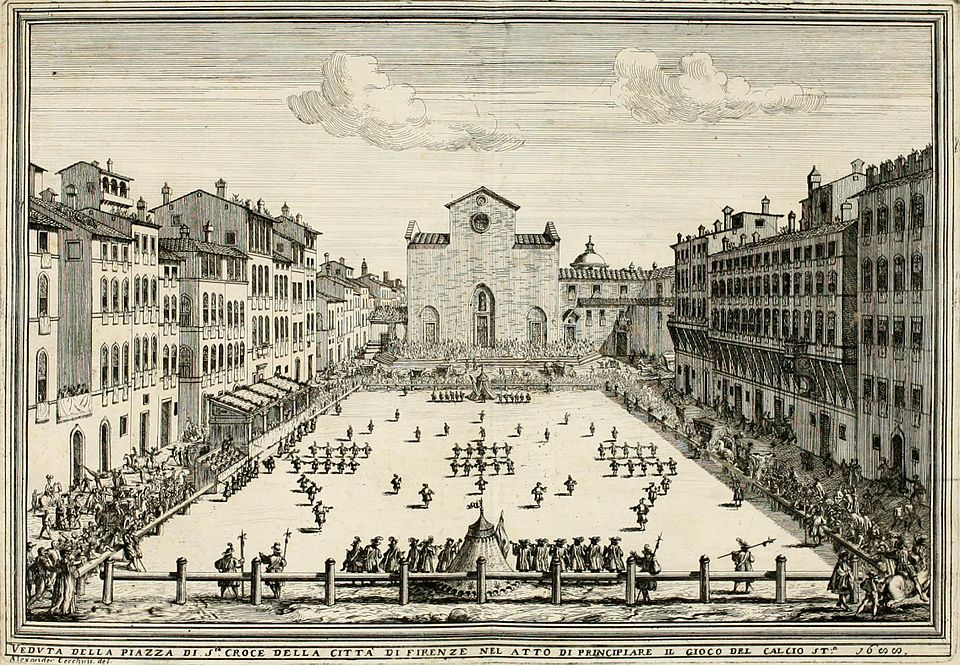
In the early 16th century (1500-1530 AD) football became popular in England. It was very different than the football known today. There were no codified rules, it was chaotic, physically aggressive and led to serious injuries. To add to the physical challenge goal posts were placed a mile apart. During the Tudor period the monarchy and aristocracy considered it a vile sport. They referred to it as “mob football” and a distraction from training for warfare. They didn’t want commoners injured at play since they needed them to fight their wars. They strongly encouraged servants and peasants to practice archery as an alternate sport to stay in shape and be prepared for war.
In 1531 Sir Thomas Elyot (c.1490-1546) English humourist scholar and diplomat wrote the manual of education for a gentleman, “The Boke Named The Gouernour”, and cited the 1389 act as justification for banning football:
“In 1389 an Act was passed (12 Ric. II. cap. 6) forbidding ‘les jeues as pelotes si bien a meyn come api ce, et les autres jeues appellez coytes, dyces, gettre de pere, keyles et autres tielx jeues importunes,’ which in the English translations of the statutes appears as ‘all playing at Tennis or Football and other games called Coits, Dice, Casting of the Stone, Kailes, and other such importune games….” Page 295 The Boke Named The Gouernour
In 1852 a scrummage in a La soule game in Basse Normandie, France:

1858 Blackheath Football Club Established
Blackheath FC team photography of 1862:

The Blackheath Football Club is currently in Well Hall, Eltham, Greenwich, London, England. The club was founded in 1858 and is“the oldest continuous running rugby club in the world”. Link to their official website is below. The club was started by Blackheath Proprietary School alumni “old boys” who were enthusiastic about playing the “carrying game” style of football (Rugby School). In 1863 the club developed the tactic of passing the ball from player-to-player. When club alumni students played against students attending the school, spectators would cheer either “club” or “school” and to this day they call out “club” when cheering for Blackheath FC.

Richard Lindon (1816-1887) English Leatherworker in Rugby, England:
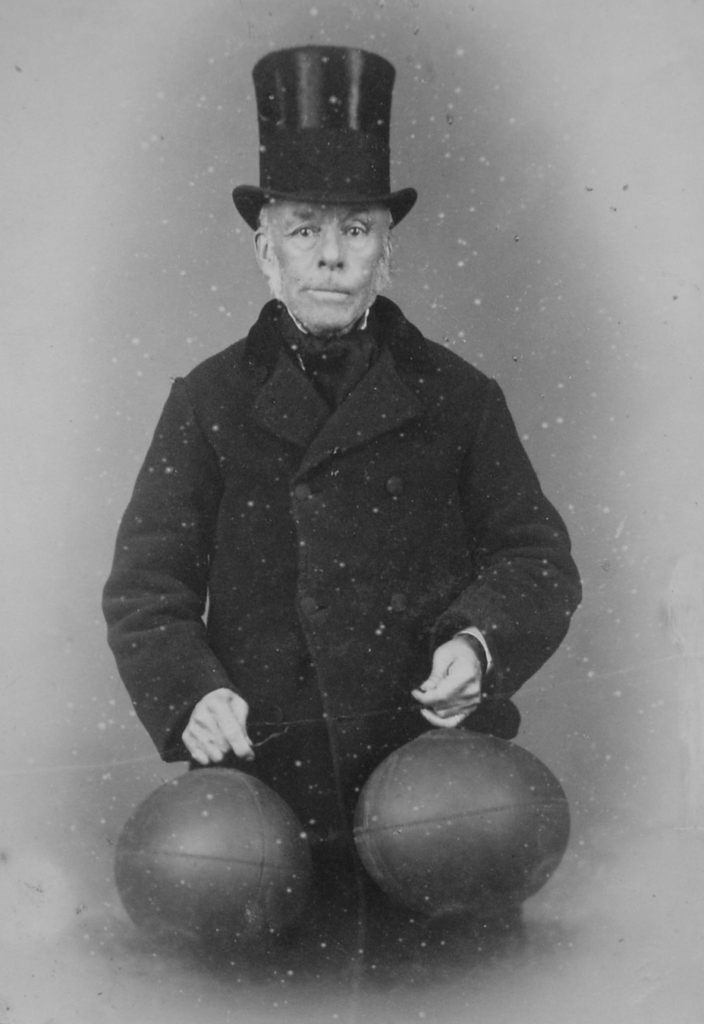
Richard Lindon (1816-1887) English Leatherworker. was born in Clifton-upon-Dunsmore just outside of Rugby, England. He set up shop as a boot and shoe maker. By 1849 due to the high demand for balls he was producing more balls than shoes. At the time pig’s bladders were inflated by mouth using a clay pipe. Then leather panels were stitched over the inflated bladder. As a result of the use of pig’s bladders the balls weren’t spherical and the size was determined by the size of the bladder.
Sadly the bladders were mouth blown by Mrs. Lindon and many of them were infected. She died prematurely from damaged lungs leaving seventeen (17) children. Due to the high risk of infection Richard Lindon sought an alternative to the pig’s bladder.
By 1861, Lindon was the principal football maker for Rugby School, Oxford, Cambridge and Dublin Universities. At the rugby players request he designed an “oval egg shaped ball“. The oval (ovoid) shape was preferred to spherical (round) for grasping with their hands.
The first inflated rubber ball had buttons on either end at the point where the stitching and leather panels met. Lindon’s panel and button design of the spherical shaped balls led to the creation of the soccer ball.
In 1862 Lindon began using “India rubber” and invented a brass object specifically to inflate the rubber balls. In London he exhibited his invention and won an award for his ingenuity.
The ball designed by Lindon that was the most popular was called the “Big Side Match Ball” and was recognized as the “true rugby ball“. The ball was manufactured for fifty years by Lindon and his son. Lindon. Lindon never patented the ball.
In the 1860s they were already playing football in Scotland and the Scottish helped introduced the sport in Belfast, Ireland in the 1870s.
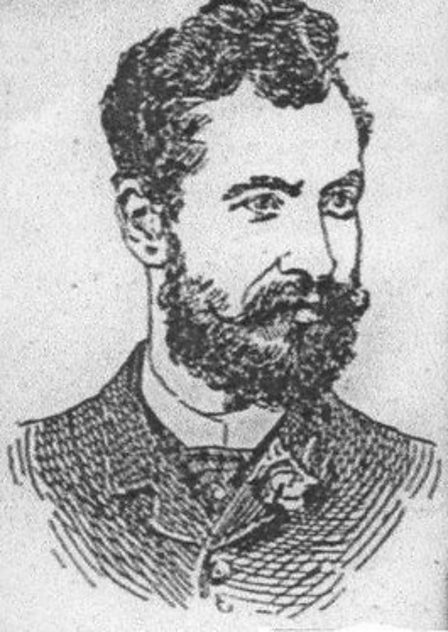
1863 ASSOCIATION FOOTBALL “SOCCER” CREATED
In 1863 the name association football, also called soccer, was created to differentiate it from rugby football.
An 1868 depiction of a “football” game in London, England. Illustration by Godefroy Durand:

In 1879 the Irish Football Club was founded by John McAlery (c.1848-1925) an Irish cricket player.
On October 23, 1878, John McAlery organized an exhibition match in Belfast, Ireland between two Scottish Teams the Caledonian (an amateur Glasgow based club) and the Queen’s Park Football Club that was founded in 1867. The exhibition game was well received and interest in football spread from Belfast to surrounding areas. More recent discoveries indicate football was played earlier in other parts of Ireland such as Cork and the claim that McAlery was the “Father of Football” in Ireland is being challenged. There’s ample evidence that McAlery contributed significantly to the establishment and popularity of the game of football in Ireland. Credit is also due to the Scottish Captains and the team players who participated in the exhibition game.
1856 LAWS OF THE UNIVERSITY FOOT BALL CLUB “CAMBRIDGE RULES” – Cambridge, England
The British excel at documenting and stipulating laws, regulations and rules for absolutely everything, including sports. In 1856 the football rules were made at the University of Cambridge University in Cambridge, England. The University Foot Ball Club Rules were established and jointly signed by officials.
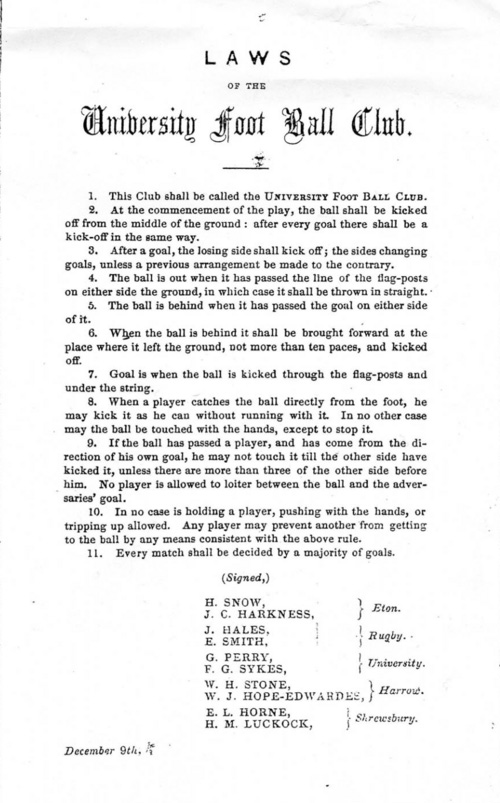
Laws of the University Foot Ball Club [1856]
- This Club shall be called the UNIVERSITY FOOT BALL CLUB.
- At the commencement of the play, the ball shall be kicked off form the middle of the ground: after every goal there shall be a kick-off in the same way.
- After a goal, the losing side shall kick off; the sides changing goals, unless a previous arrangement be made to the contrary.
- The ball is out when it has passed the line of the flag-posts on either side the ground, in which case it shall be thrown in straight.
- The ball is behind when it has passed the goal on either side of it.
- When the ball is behind it shall be brought forward at the place where it left the ground, not more than ten paces, and kicked off.
- Goal is when the ball is kicked through the flag-posts and under the string.
- When a player catches the ball directly from the foot, he may kick it as he can without running with it. In no other case may the ball be touched with the hands, except to stop it.
- If the ball has passed a player, and has come from the direction of his own goal, he may not touch it till the other side have kicked it, unless there are more than three of the other side before him. No player is allowed to loiter between the ball and the adversaries’ goal.
- In no case is holding a player, pushing with the hands, or tripping allowed. Any player may prevent another from getting to the ball by any means consistent with the above rule.
- Every match shall be decided by a majority of goals.
(Signed,)
J.H. SNOW, Eton.
J.C. HARKNESS, Eton.
J. HALES, Rugby.
E. SMITH, Rugby.
G. PERRY, University.
F.G. SYKES, University.
W.H. STONE, Harrow.
W.J. HOPE-EDWARDS, Harrow.
E. L. HORNE, Shrewsbury.
H.M. LUCKOCK, Shrewsbury.”
1861 FIRST RECORDED GAME OF CANADIAN FOOTBALL PLAYED – TORONTO, ONTARIO
On November 9, 1981 the first recorded game of Canadian Football was played by University of Toronto students. The football played was a modified version of English rugby.
1863 ASSOCIATION FOOTBALL AKA SOCCER
In 1863 Association football laws banned handing the ball and hacking. Many teams that preferred the more physically aggressive, “masculine” and challenging version broke off from the association. In 1863 when the team was considering adopting the Cambridge Rules, Cambridge strongly objected – particularly to rule# 9 and 10, which pertained to hacking. It took until 1871 for them to form a separate association.
In 1862 Frances Maule Campbell (1844-1920) Blackheath, England played for the Old Blackheathens Football Club that became Blackheath FC. Since its inception Blackheath FC intended on establishing a form of Rugby Rules. His occupation was wine merchant.
On December 1st, 1863, the fifth meeting it was proposed that the Cambridge Rules of 1856 be adopted for the Association. Campbell was strongly opposed. Cambridge motioned that the date for the final vote be postponed so members away on vacation could cast their vote. His motion was denied. On December 8, 1863, at the final meeting the motion adopt to expunge rules 9 and 10 of the Cambridge Rules was carried. They also formed the Football Association. At that meeting Campbell announced he would withdrew from playing under the new rules, but continue as treasurer to ensure the success of the Association.
Blackheath FC did not join the Football Association. They preferred to continue to play the way they had established. Ironically, in 1866 after a game scheduled between Blackheath FC and Richmond was cancelled. Both teams ended up adopting no hacking rules.
1866 INTERNATIONAL FOOTBALL ASSOCIATION BOARD (IFAB) ESTABLISHED – Manchester, England
On June 2, 1866 the International Football Association Board (IFAB) was established in Manchester, England. Today it is headquartered in Zürich, Switzerland.
1871 RUGBY FOOTBALL UNION FORMED
In 1871, English clubs who opposed the banning of handing the ball and hacking met to form the Rugby Football Union (RFU). Frances Maule Campbell participated and ended up becoming one of the individuals who was involved in the formation of both Football Association and Rugby Union.

1863 Laws of the Game set out by Football Association by Ebenezer Cobb Morley and used by International Football Association Board (IFAB) since 1886. In addition to setting out laws the Football Association banned “handling the ball” and “hacking” (kicking shins).
To follow is an excerpt from the visible portion of the above photograph of the 1863 Laws of the Game, there are words missing that were covered by the ball displayed in front of it:
A player shall be entitled to…. makes fair catch, or catches the…. he makes his mark, he shall not…write code.
Source: An early draft of the original hand-written “Laws of the Game”, drawn up on behalf of the Football Association by Ebenezer Cobb Morley in 1863, on display at the National Football Museum in Manchester.By Adrian Roebuck, CC BY-SA 3.0, https://commons.wikimedia.org/w/index.php?curid=23877204“I. The maximum length of the ground shall be 200 yards the maximum breadth shall be 100 yards, the length and breadth shall be marked off with flags or bar across them.
II. The game shall commence by a place kick from the centre of the ground by the side winning the toss, the other side of a place kick shall not approach within 10 yards of the ball until it is kicked off. After a goal is won the losing side shall be entitled to kick off.
III. The two sides shall change goals after each goal is won.
IV. A goal shall be won when the ball passes over the space between (at whatever height), not being thrown, knocked on, or carried.
V. When the ball is in touch the first player who touches it shall kick or throw it from the point of the boundary line where it left the ground, in a different direction at right angles to the boundary line.
VI. A player shall be out of play immediately he is in front of the ball and must return behind the ball as soon as possible. If the ball is licked past a player by his own side, he shall not touch or kick it or advance until one of the other side on a level with or in front of him has been able to kick it.
VII. In case the ball goes behind the goal line, if a player on the side to whom the goal belongs first touches the ball, one of his side shall be entitled to a free kick from a point 15 yards outside the goal line, opposite the place where the ball is touched.
VIII. If a player makes a fair catch he shall be entitled…..claims by making a mark with his heel at one…. go as far back as he pleases, and no player…. mark until he has kicked.

1869 FIRST AMERICAN FOOTBALL GAME BETWEEN TWO AMERICAN TEAMS – Brunswick, NJ, USA
1869.11.06 Rutgers roster for the game:

The first American football game was played on November 6, 1869, between two American college teams, Rutgers (now a University) (Piscataway, NJ and Princeton (Now a University) in Princeton in New Brunswick, NJ. The rules governing play were based on the London-based Football Association’s 1863 rules that disallowed carrying or throwing the ball and the game was described more like soccer than football. By its description some also consider it the first gridiron game.
1874 AMERICAN & CANADIAN FOOTBALL MATCH – HARVARD vs MCGILL
In 1874 a game was played between McGill, Montreal, Quebec, Canada and Harvard University, in Cambridge, Massachusetts. This is recognized as the root game of American & Canadian Football. At this game Canadian rules were adopted.
1886 INTERNATIONAL FOOTBALL ASSOCIATION BOARD – Zürich, Switzerland
On June 2, 1886, the International Football Association Board (IFAB) was established in Manchester, England. The IFAB governs and determines the “Laws of the Game” for Association Football, also called soccer, Today it is headquartered in Zürich, Switzerland.
The IFAF World Championship of American Football, known as IFAF World Cup is held every four years and is an international gridiron competition.
“RULES OF THE RUGBY UNION GAME OF FOOTBALL
As ADOPTED BY THE CANADIAN RUGBY FOOTBALL UNION
SEPTEMBER 14TH, 1880.
1. The Grounds shall be, as near as possible, 100 yards long by 50 yards broad.
2. Each Goal shall be composed of two upright posts placed 18 feet 6 inches apart, with cross-bar 10 feet from the ground.
3. A Drop Kick or Drop is made by letting the ball fall from the hands, and kicking it the very instant it rises.
4. A Place Kick or Place is made by kicking the ball after it has been placed in a nick made in the ground for the purpose of keeping it at rest.
5. A Punt is made by letting the ball fall from the hands and kicking it before it touches the ground.
6. A Goal can be obtained by kicking the ball from the field of. play direct (i.e. without touching the ground, or the dress or person of any player of either side) over the cross-bar of the opponents’ goal, whether it touch such cross-bar or posts or not; but if the ball goes directly over either of the posts it is called a poster, and is not a goal.
7. A goal may be obtained by any kind of a kick except a punt.
8. A match shall be decided by a majority of goals ; but if the number of goals be equal, or no goal be kicked, by a majority of tries; if no goal be kicked or try obtained, the match shall be drawn against that side which has been compelled to touch the ball down behind his own goal line the greater number of times.
9. The ball is dead when it rests absolutely motion-less on the ground.
10. A Touch Down is when a player, putting his hand upon the ball on the ground in goal, stops it so that it remains dead.
11. A Tackle is when the holder of the ball is held by one or more players of the opposite side.
12. A Scrimmage takes place when the holder of the ball, being in the field of play, put sit down, at his own convenience, on the ground in front of him, and all who have closed round on their respective sides endeavour to push their opponents back, and drive the ball in the direction of the opposite goal line.
13. A player may take up the ball whenever it is rolling or bounding, except in a scrimmage.
14. It is not lawful to take up the ball when dead (except in order to bring it out after it has been touched down in touch or in goal) for any purpose what-ever; whenever the ball shall have been so unlawfully taken up, it shall at once be brought back to where it was so taken up, and there put down.
15. In a scrimmage it is not lawful for any man to pick out the ball, or to touch it with the band, under any circumstances whatever.
16. It is not lawful to carry the ball by the string. It is lawful to run in anywhere across the goal line.
18. The goal line is in goal, and the goal line in touch.
19. In the event of any player holding or sunning with the ball being tackled, and the ball fairly held, he must at once cry down, and there put it down.
20. A Maul in Goal is when the holder of the ball is tackled inside goal line, or, being tackled immediately outside, is carried or pushed across it, and he, or the opposite side, or both, endeavour to touch the ball down. In all cases, when so touched down, the ball shall belong to the players of the side who first had possession of it before the maul commenced, unless the opposite side have gained complete possession of it.
21. In case of a maul in goal, those players only who are touching the ball with their hands when it crosses the goal line may continue the maul in goal, and when a player has once released his hold of the ball after it is inside the goal line he may not again join in the maul, and if he attempts to do so may be dragged out by the opposite side.
22. But, if a player when running in is tackled in-side the goal line, then only the player who first tackled him, or if two or more tackle simultaneously, they only may join in the maul. A maul in goal must not last longer than two minutes, the ball be-longing to him who had first possession of it.
23. Touch in Goal. Immediately the ball, whether in the hands of a player (except fur the purpose of a punt out—see Rule 31) or not, goes into touch in goal, it is at once dead and out of the game, and must be brought out as provided by Rules 42 and 43.
24. Every player is on side, but is put off side if he enters a scrimmage from his opponent’s side, or, being in a scrimmage, gets in front of the b:ll, or when the ball has been kicked, touched, or is being run with by any of his own side behind him (7.e, between him-self and his goal line). No player can be off side in his own goal.
25. Every player when off side is out of the game, and shall not touch the ball in any case whatever, either in or out of touch or goal, or in any way interrupt or obstruct any player until he is again on side.
26. If a player purposely foul an opponent in order to gain ground for his own side, the opponent’s side may either have the ball down where the foul was made, or take a free kick, which free kick cannot possibly score a goal. The purpose of the foul must be decided by the referee.
27. A player being of side is put on side when the ball has been kicked, or run with five yards by any player of the opposite side, or when one of bis own side has run in front of him, either with the ball or having kicked it when behind him. When a player has the ball, none of his opponents who at the time are off side may attempt to tackle, or otherwise interrupt such player till be has run five yards.
28. Throwing Back. Itis lawful for any player who has the ball to throw it back towards his own goal, or to pass it back to any player of his own side who is at the time behind him.
29. Knocking on, i.e., deliberately hitting the ball with the hand. and Throwing Forward, i. e., throwing the ball in the direction of the opponents’ goal line, are not lawful. If the ball be either knocked on or thrown forward, the Captain of the opposite side may (unless a fair catch has been made, as provided by the next Rule) require to have it brought back to the spot where it was knocked or thrown on, and there put down.
30. A Fair Catch is a catch made direct from a kick, or a throw forward, or a knock on by one of the opposite side, or from a punt out (see Rule 31), provided 6 the catcher makes a mark with his heel at the spot where he has made the catch, and no other of his own side touch the ball (see Rules 44 and 45).
31. A Punt out is a punt made after a touch down by a player from behind his opponents’ goal line, and from touch in goal if necessary, towards his own side, who must stand outside the goal line and endeavour to make a fair catch, or get the ball and run in or drop a goal (see Rules 49, 50 and 51).
32. A Punt on is a punt made in a manner similar to a punt out, and from touch if necessary, by a player who has made a fair catch from a punt out or another punt on.
33. Touch. If a ball goes into touch, the first player on his side who touches it down must bring it to the spot where it crossed the touch line; or if a player, when running with the ball, cross or put any part of either foot across the touch line, he must return with the ball to the spot where the line was so crossed, and thence return it into the field of play in one of the modes provided by the following Rule :—
34. He must then himself or by one of his own side, either, (i.) bound the ball in the field of play at right angles to the touch line, and then run with it, kick it, or throw it back to his own side; or (ii.) throw it out at right angles to the touch line ; or (iii.) walk out with it at right angles to the touch line, any distance not less than five nor more than fifteen yards, and there put it down, first declaring how far he intends to walk out.
35. If two or more players holding the ball are pushed into touch, the ball shall belong in touch to the to player who first had hold of it in the field of play, and has not released his hold of it.
36. If the ball when thrown out of touch be not thrown out at right angles to the touch line, the Captain of either side play at once claim to have it thrown out again.
37. A catch made when the ball is thrown out of touch is not a fair catch.
38. A Kick off is a place kick from-the centre of the field of play, and cannot count as a goal. The opposite side must stand at least ten yards in front of the ball until it has been kicked.
39. The ball shall be kicked off, (i.) at the commencement of the game; (ii.) after a goal has been obtained; and (iii.) after change of goals.
40. The Captains of the respective sides shall toss up – before the commencement the Match; the winner of the toss shall have the option of the choice of Goal, or of kick off. They shall also arrange the time of play.
41. Whenever a Goal shall ‘have been obtained, the side which has lost the Goal shall then kick off.
42. Kick out is a drop kick by one of the players of the side which has had to touch the Ball down in their own goal, or into whose touch in goal the ball has gone, (Rule 23) and is the mode of bringing the ball again into play, and cannot count as goal.
43. Kick out must be a drop kick, and from not more than twenty-five. yards outside the kicker’s goal; if the ball, when kicked out, pitch in touch, it must be taken back and kicked out again. The kicker’s side must be behind the ball when kicked out.
44. A player who has made and claimed a fair catch shall thereupon either take a drop kick or punt, or place the ball for a place kick.
45. After a fair catch has been made, the opposite side may come up to the catcher’s mark, and (except in cases under Rule 50) the catcher’s side retiring, the ball shall be kicked from such mark, or from a spot any distance behind it.
46. A player may touch the ball down in his own goal at any time.
47. Aside having touched the ball down in their opponents’ goal, shall try at goal either by a place kick or a punt out.
48. If a try at goal be made by a place kick, a player of the side which has touched the ball down shall bring it up to the goal line in a straight line from and opposite to the spot were the ball was touched down, and there make a mark on the goal line, and thence walk straight out with it at right angles to the goal line, to such distance as as he thinks proper, and there place it for another of his side to kick. The kicker’s side must be behind the ball when it is kicked, and the opposite side must remain behind their goal line until the ball has been placed on the ground.
49. If the try at goal be by a punt out (see Rule 31) a player of the side which has touched the ball down shall bring it straight up to the goal line opposite to the spot where it was touched down, and there make a mark on the Goal line, and then punt out from touch in goal, if necessary, or from any part behind the goal line not nearer to the goal post than such mark, beyond which mark it is not lawful for the opposite side (who must keep behind their goal line) to pass until the ball has been kicked. (See Rules 54 and 55.)
50. If a fair catch be made from a punt out or a punt on the catcher may either proceed as provided by Rules 45 and 49, or himself take a punt on, in which case the mark made on making the fair catch shall be regarded (for the purpose of determining as well the position of the player who makes the punt on as of the other players of both sides) as the mark made on the Goal line in the case of a punt out.
51. A catch made in touch from a punt out or a punt on is not a fair catch; the ball must then be taken or thrown out of touch as provided by Rule 33; but if. the catch be made in touch in Goal, the ball is at once dead, and must be kicked out, as provided by Rules 42 and 43.
52. When the ball has been touched down in the opponents’ Goal, none of the side in whose Goal it has been so touched down shall touch it, or in any way displace it, or interfere with the player of the other side who may be taking it up or not.
53. The ball is dead whenever a Goal has been obtained; but if a try at Goal be not successful, the kick shall be considered as only an ordinary kick in the course of the game.
54. Charging, i.e., rushing forward to kick the ball, or tackle a player, is lawful for the opposite side in all cases of a place kick after a fair catch, or upon a try at Goal, immediately the ball touches, or is placed on the ground; and in cases of a drop kick or punt after a fair catch, as soon as the player having the ball commences to run or offers to kick, or the ball has touched the ground: but he may always draw back, and unless he has dropped the ball, or actually touched it with his foot, they must again retire to his mark (see Rule 48). The opposite side in the case of a punt out or a punt on, and the kicker’s side in all cases may not charge until the ball has been kicked.
55. If a player having a ball, when about to punt it out, goes outside the goal line, or when about to punt on, advances nearer to his own goal line than his mark, made on making the fair catch, or if, after the ball bas been touched down in the opponents’ goal or a fair catch has been made, more than one player on the side which has so touched it down or made the fair catch, touch the ball before it is again kicked, the opposite side may charge at once.
56. In cases of a fair catch the opposite side may come up to and charge from anywhere on or behind a line drawn through the mark made by the player who has made the catch, and parallel to their own goal line ; but in the case of a fair catch from: a punt out or a punt on, they may not advance further in the direction of the touch line nearest to such mark than a line drawn through such mark to their goal line, and parallel to such touch line. In all cases (except a punt out and a punt on) the kicker’s side must be behind the ball when it is kicked, but may not charge until it has been kicked.
57. No HACKING or THROTTLING, e, or tipping up shall be allowed under any circumstances.
58. No one wearing projecting nails, iron plates, or gutta percha, on any part of his boots or shoes, shall be allowed to play in a match.
59. The Captains, unless umpires be appointed, shall be the sole arbiters to all disputes, and their decision shall be final, If the Captain of either side challenge the construction placed upon any rules, he shall have the right of appeal to the Rugby Union Committee.
60. Neither time nor on-side shall be called until the ball is fairly held, or goes out of play, and in the case of a try or fair catch, the kick at goal shall be allowed.”
1903 ONTARIO RUGBY FOOTBALL UNION ADOPTED THE BURNSIDE RULES
The Burnside Rules transformed Canadian Football from a rugby style to gridiron-iron style.
Although rules didn’t originate with him, they were named after John Thrift Meldrum Burnside the captain of the University of Toronto football team.
Some of the sweeping changes to the rules included:
- A reduction from 15 to 12 players per side
- A reduction from 8 to 6 men allowed on the line of scrimmage when the ball was put into play
- the “snap-back” system in which the ball was passed backward from a static line of scrimmage by the centre
- a requirement for a team to make ten yards in three successive downs or lose possession of the ball
Source: https://en.wikipedia.org/wiki/Burnside_rules
1908 France painting of football players by Henri Rousseau (1844-1910) French Post Impressionist artist:

1910 The Sportsman Newspaper front page header below of dated November 25, 1910. It illustrates the continued use of the word “football” to encompass both rugby and association football:

1914-1918 WORLD WAR ONE THE GREAT WAR

World War I or the First World War, also known as The Great War, was a global conflict between two coalitions: the “Allied” Countries & “Central” Powers. Professional games were suspended in several countries. For the military, team sports such as baseball, football, rugby and soccer fostered camaraderie and cohesion among soldiers during the war.
1914 CHRISTMAS TRUCE – BRITISH & GERMAN SOLDIERS PLAYED FOOTBALL IN NO MAN’S LAND
The Christmas truce was a series of widespread unofficial ceasefires mainly along the Western Front of the First World War around Christmas in 1914. Undoubtedly faith and sportsmanship can bring out the best behaviour at the worst of times. In 1914 there were reports of soldiers crossing over into no mans land and having conversations, singing carols and even playing football.
Many of our ancestors died or lost husbands, wives, sons and daughters to this global conflict. While reading the October 19, 1918 Border City News Border City Era newspaper I found one such example of a 24 years old rugby athlete whose life was cut short in defense of our country.
DIES ON FIELD OF HONOR
Liet. Stanley Reaume, (1893-1916) son of Dr. J. O. Reaume, county register of deeds and former minister of public works was reported missing a few years ago and now recorded as killed. He went overseas with the first contingent and served with the Royal Scots returning in 1916 as machine gun instructor and taking up this work with the 241st kilted battalion. “Stan was extremely popular and a well-known athlete, having played with the Toronto Argos when this team won the rugby championship.
Source: Border City News October 19, 1918
Military service: Age: 24 Rank: Lieutenant Force: Army Unit/Regiment: Canadian Infantry (Quebec Regiment) Division: 13th Bn. Birth: October 10, 1893 Windsor, Ontario Enlistment: September 1, 1916 Windsor, Ontario Death: October 1, 1918

1920 A.G. Spalding and Bros. Advertisement – soccer balls, soccer ball bladders, canvas covers and nets:

Walkerville Football Club 1926-1927 “Actually Soccer”:
Walkerville Football Club 1926-1927 Year: 1927 Type(s): Photograph
Source: Southwestern Ontario Digital Archive Tony Techko Collection
1936 ANNUAL 7th Year Illustrated Football Magazine:
Features 600 photos of star players and Official Nationwide Schedules and is a useful resource for collectors of football memorabilia.
To view or download a copy visit Internet Archive:
Illustrated Football 1936 Annual, Volume 7 by Fiction House Inc. Publication date 1936. Item Size 76.4M
https://archive.org/details/illustrated-football-1936-annual

World War Two Wartime poster for the United Nations, created in 1941 by the U.S. Office of War Information:

World War II or the Second World War from September 1, 1939 to September, 1945 was a global conflict between two coalitions: the “Allies” and the “Axis” powers. Nearly all of the world’s countries got involved and had to mobilize all their resources in pursuit of total war.
Major player shortages occurred. Amateur players, professional players and coaches left to join the front lines. Many civilian leagues suspended play due to player shortages. Universities suspended football programs. Some teams temporarily merged with other teams and allowed guest players. During the 1942 Grey Cup two Royal Canadian Air Force Teams competed.
Within the military organized sports were prioritized as a means to stay physically fit and raise morale. Military teams organized locally and abroad. Competitive sports for the military were organized as a priority to boost mental well being, improve fitness and maintain high troop morale.
1945-1952 The Windsor Royals Football Team was part of the Ontario Rugby Football Union (ORFU). A league that preceded the Canadian Football League. In 1945 they were called the Windsor Rockets.
The 1948 Windsor Rockets (ORFU):
https://profootballarchives.com/1948 Windsor Rockets
In 1858, the Canadian Football League (CFL) was founded and is the highest level of professional Canadian football.
BIBLIOGRAPHY
https://en.wikipedia.org/wiki/Cambridge_rules
https://en.wikipedia.org/wiki/Laws_of_the_Game_(association_football)
How to play “soccer,” by McWeeney, J. A., [from old catalog] ed; Bloomer, Stephen. [from old catalog] Publication date 1920. Publisher New York, American sports publishing company Collection The Library of Congress Item Size 222.0M
https://archive.org/details/howtoplaysoccer00mcwe
The rules of Rugby Union Football Rules of the rugby union game of football [microform]: as adopted by the Canadian Rugby Football Union, September 14th, 1880 by Canadian Rugby Football Union Publication date 1882 Publisher Ottawa : Citizen Printing & Pub. Co. Collection. University of Alberta, Toronto; microfilm Contributor Canadiana.org Language English Item Size 22.1M
https://archive.org/details/cihm_00946
Dominion Football Association by Brown, David K; Dominion Football Association. Publication date 1879 Publisher Toronto : J.R. Robertson Language English Item Size 42.6M
https://archive.org/details/cihm_10172
The evolution of the pigskin by Jefferys, Charles William, 1869-1951; Jefferys, Charles William, 1869-1951 Publication date 1912 Contributor Queen’s University Library, W.D. Jordan Special Collections and Music Library Language English Item Size 21.8M Small booklet with hand-made paper cover and tied with string
https://archive.org/details/evolutionofpigsk00jeff
RELEVANT LINKS
Association Football – FIFA World Cup
https://en.wikipedia.org/wiki/FIFA_World_Cup
https://en.wikipedia.org/wiki/Blackheath_F.C.
https://en.wikipedia.org/wiki/American_football
https://en.wikipedia.org/wiki/Canadian_football
Canadian Football League:
Memorie del calcio fiorentino : tratte da diverse scritture e dedicate all’ Altezze Serenissime di Ferdinando principe di Toscana e Violante Beatrice di Baviera by Bini, Pietro di Lorenzo; Nacci, Francesco, 17th cent; Cecchini, Alessandro, 17th cent; Matini, Piero, fl. 1684-1700; Stamperia di S.A.S. alla Condotta. Publication date 1688 Topics: ….Florentine football — Early works to 1800… Prince of Tuscany, 1673-1731, Marriage. Publisher: In Firenze : Nella Stamperia di S.A.S. alla Condotta Language: Italian; Ancient Greek; Latin. Item Size 157.5M Source: Internet Archive: https://archive.org/details/memoriedelcalcio00bini
Christie’s Live Auction 2178 Lot 129 Closed June 12 2009
FLORENCE 1688 — BINI, Pietro, editor. Memorie del calcio fiorentino. Tratte da diverse scritture. Florence: Stamperia di S.A.S. alla Condotta, 1688.
https://www.christies.com/en/lot/lot-5213960
Comparison of American Football to Rugby League:
https://en.wikipedia.org/wiki/Comparison_of_American_football_and_rugby_league
International Football Association Board Zürich, Switzerland.
https://en.wikipedia.org/wiki/International_Football_Association_Board
Gridiron Football:
https://en.wikipedia.org/wiki/Gridiron_football
Christmas Truce:
https://en.wikipedia.org/wiki/Christmas_truce
National Football League United States:
https://en.wikipedia.org/wiki/Richard_Lindon
School District No. 43 (Coquitlam, BC) Learning for a Lifetime
www.sd43.bc.ca/Rugby for Dummies Cheet Sheet
https://www.veterans.gc.ca/en/remembrance/memorials/canadian-virtual-war-memorial/601412
Rugby League
Rugby Union – Rugby World Cup
https://en.wikipedia.org/wiki/Rugby_World_Cup
World Rugby is the worldwide governing body and law making authority for Rugby Union, visit their website for relevant information about “Rugby Union” today.
School District No. 43 (Coquitlam, BC, Canada) Learning for a Lifetime posts a guide online “Rugby for Dummies Cheet Sheet”:
www.sd43.bc.ca/Rugby for Dummies Cheet Sheet
https://en.wikipedia.org/wiki/Toronto_Argonauts
Southwestern Ontario Digital Archive: